Resident Physician Icahn School of Medicine at Mount Sinai, New York, United States
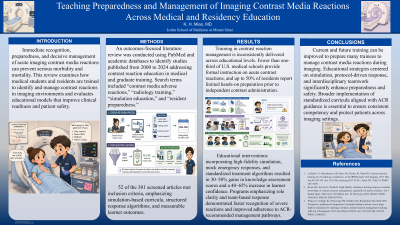
Purpose: Immediate recognition, preparedness, and decisive management of acute imaging contrast media reactions can prevent serious morbidity and mortality. This review examines how medical students and residents are trained to identify and manage contrast reactions in imaging environments and evaluates educational models that improve clinical readiness and patient safety.
Methods/Materials: An outcomes-focused literature review was conducted using PubMed and academic databases to identify studies published from 2000 to 2024 addressing contrast reaction education in medical and graduate training. Search terms included “contrast media adverse reactions,” “radiology training,” “simulation education,” and “resident preparedness.” 52 of the 301 screened articles met inclusion criteria, emphasizing simulation-based curricula, structured response algorithms, and measurable learner outcomes.
Results: Training in contrast reaction management is inconsistently delivered across educational levels. Fewer than one-third of U.S. medical schools provide formal instruction on acute contrast reactions, and up to 50% of residents report limited hands-on preparation prior to independent contrast administration. Educational interventions incorporating high-fidelity simulation, mock emergency responses, and standardized treatment algorithms resulted in 30–50% gains in knowledge assessment scores and a 40–65% increase in learner confidence. Programs emphasizing role clarity and team-based response demonstrated faster recognition of severe reactions and improved adherence to ACR-recommended management pathways.
Conclusions: Current and future training can be improved to prepare many trainees to manage contrast media reactions during imaging. Educational strategies centered on simulation, protocol-driven response, and interdisciplinary teamwork significantly enhance preparedness and safety. Broader implementation of standardized curricula aligned with ACR guidance is essential to ensure consistent competency and protect patients across imaging settings.