Medical Officer University of the West Indies, United States
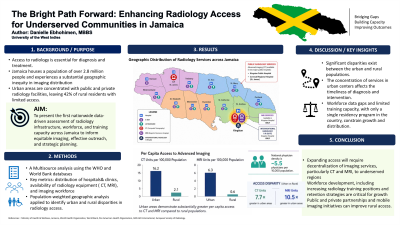
Purpose: Access to radiology is essential for diagnosis and treatment; however, Jamaica's population of 2.8 million experiences a substantial geographic inequity in imaging distribution. Urban areas are concentrated with public and private radiology facilities, leaving 42% of rural residents with limited access. This study presents the first nationwide data-driven assessment of radiology infrastructure, workforce, and training capacity across Jamaica to inform equitable imaging, effective outreach, and strategic planning
Methods/Materials: A methodical, multisource analysis of Jamaica's healthcare and radiology infrastructure was conducted, utilizing government reports, the WHO, and the World Bank database. Key metrics included the geographic distribution of hospitals and clinics across the island, availability of radiology equipment (CT, MRI, fluoroscopy), and imaging workforce capacity. Population-weighted geographic analysis was applied to identify and quantify urban and rural disparities in radiology access.
Results: Systemic analysis revealed significant inequities. Public radiology services are concentrated in two major hospitals, while private centers provide advanced imaging in largely limited urban areas. Urban regions demonstrated substantially greater per capita access to CT and MRI compared to rural populations. National physician density is approximately 5.5 physicians per 10,000 population, but comprehensive radiologist workforce data are unavailable, representing a critical gap. Diagnostic and interventional radiology training is restricted to one institution nationwide thus constraining workforce expansion and development.
Conclusions: Jamaica faces significant disparities in radiology access within the rural areas. This structured, reproducible framework identifies high-need areas and provides actionable radiologist-led recommendations. Targeted leadership driven intiatives facilitating strategic equipment distribution, collaborative outreach with academic partners, and workforce development can inherently enhance equitable access, diagnostic capacity, and patient outcomes. This approach offers a model for data-driven imaging equity planning in Jamaica and other resource-limited settings.