Physician in Radiodiagnosis JEFFERSON ABINGTON HOSPITAL Huntingdon Valley, Pennsylvania, United States
Purpose: The purpose of this study is to evaluate the US national and global trend in artificial intelligence (AI)-based research productivity involving radiology and its subspecialty disciplines.
Methods/Materials: All publication searches were performed using a comprehensive central database that searches the world's leading scholarly journals in the sciences and includes the PubMed databases.
From 2022to 2026, all AI-related publications were selected using the following search terms: “artificial intelligence,” “radiodiagnosis.”
The resulting publication database was then categorized by country of origin, publication type, and journal.
Nine radiology subspecialty publications were evaluated.
The global trend in the number of AI publications from 2022 to 20126 including contributing countries, was determined by linear and nonlinear regression analyses performed using a statistical software program; p ≤ 0.05 was considered significant.
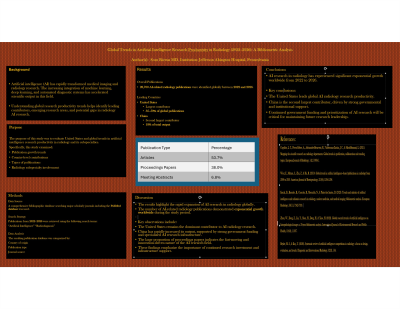
Results: Our bibliometric analysis yielded 28,700 radiology AI publications worldwide from 2022 to 2026. The United States had the highest AI publication output , accounting for approximately 35–50% of the total output. China was the second most productive country in the world, contributing 18% of the total output
The types of publications identified most often were articles (53.7%), proceedings papers (38.0%), and meeting abstracts (6.8%).
Conclusions: Exponential growth in AI radiology research has occurred worldwide, with the United States leading overall AI research productivity. China has made the second biggest contribution, largely driven by unique research infrastructure ideal for AI research and significant government funding support. The future success of the United States will depend on continued government funding and prioritization of AI radiology research within the research community.