Associate Professor The Ohio State University College of Medicine, United States
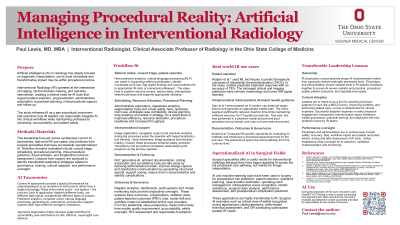
Purpose: Artificial intelligence (AI) in radiology has largely focused on diagnostic interpretation, yet its most immediate and transformative impact may be within procedural practice. Interventional Radiology (IR) operates at the intersection of imaging, clinical decision-making, and real-time intervention, creating a distinct need for AI tools that support procedural planning, execution, and follow-up. This session reframes AI as a procedural instrument and examines how IR leaders can responsibly integrate AI into clinical workflows while maintaining professional ownership, accountability, and patient safety.
Methods/Materials: This leadership-focused review synthesizes current AI taxonomies, real-world IR use cases, and evidence from surgical specialties that have successfully operationalized AI. Workflow domains evaluated include consult triage, scheduling, procedural planning, intra-procedural guidance, documentation, and longitudinal outcome assessment. Lessons from surgery are analyzed to identify transferable leadership strategies related to governance, training, cultural adoption, and performance oversight.
Results: Across surgical disciplines, AI adoption has demonstrated improvements in decision support, operational efficiency, procedural precision, and training effectiveness when deployed as a clinician-guided tool rather than an autonomous system. These benefits are contingent on physician-led design, transparent validation, and defined accountability structures. For IR, AI applications are most impactful when embedded within procedural workflows and aligned with existing quality, safety, and practice management frameworks, reinforcing—rather than diluting—the proceduralist’s role.
Conclusions: AI integration in IR is no longer a theoretical exercise but a leadership imperative. Successful adoption requires intentional governance, education, and ownership by proceduralists. By treating AI as a clinical instrument—subject to training, credentialing, and oversight—proceduralists and leaders can shape AI deployment to enhance efficiency, consistency, and patient outcomes while safeguarding professional identity and clinical responsibility.