Medical Student Des Moines University College of Osteopathic Medicine, United States
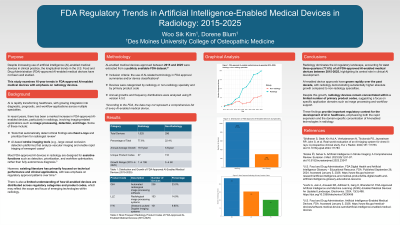
Purpose: Despite increasing use of artificial intelligence (AI)-enabled medical devices in clinical practice, the longitudinal trends in the U.S. Food and Drug Administration (FDA)-approved AI-enabled medical devices have not been well studied. This study examines 10-year trends in FDA-approved AI-enabled medical devices with emphasis on radiology devices.
Methods/Materials: AI-enabled medical devices approved between 2015 and 2025 were extracted from a publicly available FDA dataset. Inclusion criteria were the use of AI-related terminology in FDA approval summaries and/or device classifications. According to the FDA, the data may not represent a comprehensive list of every AI-enabled medical device. The devices were categorized by radiology or non-radiology specialty and by primary product code. Their annual growths and frequency distributions were analyzed using R version 4.5.0.
Results: A total of 1,321 FDA-approved AI-enabled medical devices were identified between 2015 and 2025. Radiology accounted for 1,025 devices (77.6%), while non-radiology specialties accounted for 296 devices (22.4%). Approval for radiology devices increased from 1 device in 2015 to 198 devices in 2025 (Figure 1) with an average absolute growth of 19.7 devices per year, compared to 5 to 60 devices for non-radiology devices, which had a lower average absolute growth of 5.5 devices per year. Radiology devices accounted for 37 unique primary product codes, compared to 116 among non-radiology devices. The most frequent primary product codes for radiology devices were QIH (automated radiological image processing software; 236 devices, 23.0%), LLZ (radiological image processing systems; 153, 14.9%), and IYN (ultrasonic pulsed Doppler imaging systems; 101, 9.85%).
Conclusions: From 2015 to 2025, radiology accounted for the majority of FDA approvals for AI-enabled medical devices and demonstrated faster growth than non-radiology specialties. Despite this, radiology devices spanned a limited number of unique primary product codes, with automated radiological image processing comprising the largest portion. Together, these findings provide important regulatory context regarding the pace and focus of AI-enabled medical devices entering radiology.