Resident Physician University of Chicago Medicine, Illinois, United States
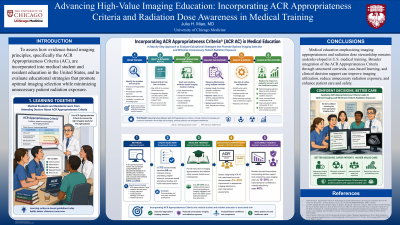
Purpose: To assess how evidence-based imaging principles—specifically the ACR Appropriateness Criteria (AC)—are incorporated into medical student and resident education in the United States, and to evaluate educational strategies that promote optimal imaging selection while minimizing unnecessary patient radiation exposure.
Methods/Materials: A structured narrative review was conducted using PubMed and educational databases to identify peer-reviewed studies, national surveys, and curricular interventions published between 2003 and 2024. Search terms included “ACR Appropriateness Criteria,” “radiation dose education,” “imaging utilization,” “medical student radiology curriculum,” and “resident education.” Of 312 articles initially identified, 64 met inclusion criteria, prioritizing original research, outcomes-based educational studies, and multi-institutional reports. Commentaries and non–peer-reviewed publications were excluded.
Results: Formal instruction on imaging appropriateness and radiation safety remains limited across training levels. Only 20–30% of U.S. medical schools report structured teaching on imaging utilization, and fewer than 25% require dedicated radiation dose education. Studies integrating ACR AC into case-based curricula demonstrated a 15–35% improvement in appropriate imaging selection on post-intervention assessments. Resident-focused interventions incorporating decision support tools reduced low-value imaging orders by 12–28% and improved learner confidence in modality selection by over 40%.
Conclusions: Education emphasizing imaging appropriateness and radiation dose stewardship remains underdeveloped in U.S. medical training. Broader integration of the ACR Appropriateness Criteria through structured curricula, case-based learning, and clinical decision support can improve imaging utilization, reduce unnecessary radiation exposure, and enhance patient safety. National educational standards and institutional investment are essential to ensure consistent, high-value imaging education across the medical education continuum.