Resident Physician Integris Baptist Medical Center Oklahoma City, Oklahoma, United States
Purpose: Pediatric interventional radiology (PIR) provides essential minimally invasive care for medically complex children but is financially vulnerable due to disproportionate reliance on Medicaid reimbursement. Recent Medicaid eligibility reductions and reimbursement pressures raise concerns regarding PIR sustainability and access to specialized pediatric care. This abstract presents a structured framework to assess practice vulnerability under Medicaid policy shifts.
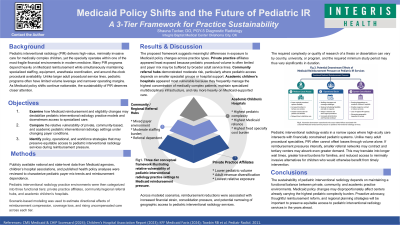
Methods/Materials: Publicly available national and state-level data from Medicaid agencies, children’s hospital associations, and published policy analyses were reviewed to characterize pediatric payer mix and reimbursement patterns. A three-tier framework was developed to describe PIR practice structures across private practices, community-based hubs, and academic children’s hospitals. Scenario-based modeling assessed the directional impact of Medicaid eligibility reductions and coverage denials on service sustainability across these settings.
Results: Children represent a substantial proportion of Medicaid and CHIP enrollees, with PIR practices carrying a higher Medicaid payer mix than adult procedural specialties. Within the three-tier framework, private practices were least exposed to Medicaid policy shifts due to limited pediatric volume. Community-based hubs and academic children’s hospitals demonstrated greater vulnerability because of higher Medicaid volumes and resource-intensive care. Modeled reductions in eligibility or reimbursement were associated with increased financial strain, consolidation pressure, and narrowing of access at regional referral centers.
Conclusions: Pediatric interventional radiology sustainability depends on balance across private, community, and academic practice structures. Medicaid eligibility and reimbursement changes risk destabilizing this balance, with disproportionate effects on safety-net and children’s hospitals. This framework offers a policy-relevant tool for leadership planning and advocacy to preserve equitable access to pediatric interventional care.