Division Chief Nuclear Medicine University of Vermont Medical Center, United States
Purpose: To evaluate the impact of a generative AI tool (Nuance PowerScribe Smart Impression) on workflow efficiency, perceived workload, and burnout among attending radiologists, and to determine whether efficiency gains translate into reduced clinician strain.
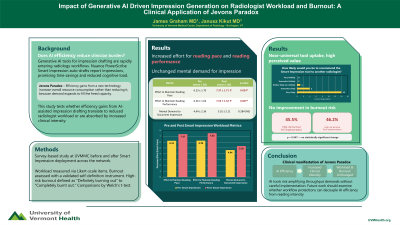
Methods/Materials: A survey-based study was conducted among attending radiologists at the University of Vermont Medical Center before (n = 40) and after (n = 19) implementation of a generative AI tool that drafts impressions. Workload was assessed using Likert-scale items including: “How hard do you have to work to accomplish your level of reading performance?”, “How mentally demanding is it to read studies at your current pace?”, and “How mentally demanding is it to document your impression?”. Burnout was assessed using a validated self-definition measure. High-risk burnout was defined as responses ranging from “Definitely burning out” to “Completely burnt out.” Tool value and usage were also assessed. Pre- and post-implementation comparisons were performed using Welch’s t-test.
Results: Following implementation, the AI tool achieved near-universal acceptance, with 94.7% of respondents reporting added value and 47.4% using it for every report. Despite high adoption, subjective workload increased. Mean effort to accomplish reading performance increased from 4.64 to 5.32 (p = 0.007), and mental demand of reading at the current pace increased from 6.23 to 7.37 (p = 0.024). In contrast, mental demand of impression documentation did not significantly change (p = 0.284). There was no improvement in burnout; high-risk burnout remained unchanged (45.5% pre vs. 46.2% post; p = 0.967).
Conclusions: The deployment of generative AI driven impression drafting represents a clinical manifestation of Jevons paradox. Although the tool was rapidly adopted and perceived as valuable, efficiency gains were associated with increased perceived effort and reading-related mental demand, without improvement in burnout. These findings suggest that absent institutional guardrails, efficiency gains from AI may be absorbed by increased clinical intensity rather than translating into reduced clinician strain.