Radiology Program Director McMaster University, United States
Purpose: Independent after-hours radiology resident reports are essential for 24 hour clinical care. Identifying and characterizing discrepancies between preliminary reports and finalized staff reports is critical as it helps identify trainees who may need extra support and also address broader educational needs. The goal of this quality-improvement study was to determine rates and types of discrepancies at our academic institution and compare to the literature.
Methods/Materials: Radiology reports by PGY2-4 residents from representative summer, fall and winter months of July 2024, October 2024, and January 2025 respectively were assessed. Following comparison, discrepant reports were divided into four subcategories: 1) Change or addition to primary diagnosis, 2) Findings necessitating urgent follow-up imaging, 3) Findings necessitating return to emergency and 4) Incidental findings with non-urgent follow-up.
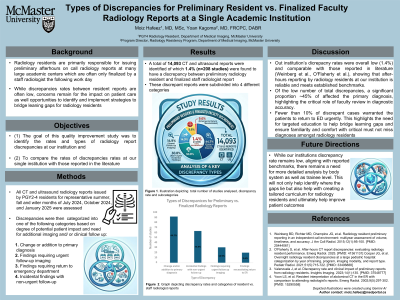
Results: A total of 14,093 CT and US studies were identified in this retrospective review. Of these studies, 208 (1.4%) had a discrepancy. Amongst these, 93 (44.7%) involved a change or addition to the primary diagnosis, 64 (30.8%) involved incidental findings with non-urgent follow-up, 31 (14.9%) required urgent follow-up imaging and 20 (9.6%) necessitated an urgent return to the emergency department. Results are summarized in Figure 1.0.
Conclusions: Our institution’s discrepancy rates are low and comparable to those reported in the literature. Future studies should aim to understand how discrepancies vary based on trainee level, body system, and imaging modality. Such work will not only help mitigate any potential negative clinical outcomes stemming from discrepancies, but will also help identify areas for targeted educational activities for radiology residents.