Application of IDEAL-IQ to quantitatively evaluate fat deposition and iron overload in abdominal parenchymal organs in rats with type 2 diabetes mellitus
Head of Department of Radiology Bishan Hospital of Chongqing Medical University Chongqing, Chongqing, China (People's Republic)
Purpose: MRI IDEAL-IQ technique was utilized to non-invasively and quantitatively assess fat deposition and iron deposition in the liver, kidney and pancreas of type 2 diabetic rats, as well as to study the relationship between blood glucose, body weight, and fat deposition and iron deposition in type 2 diabetic rats.
Methods/Materials: Ten male SD rats were divided into two groups. The experimental group was subjected to the establishment of a model of type 2 diabetes mellitus, and after the model was formed, an MRI scan was performed to observe the imaging performances between the experimental group and the control group, to quantitatively assess the fat deposition and iron overload in the liver, kidneys, and pancreas, and to assess the changes in liver function, renal function, and lipids by blood sampling from the heart at the end of the scanning process. The liver, kidney and pancreas were taken at execution for routine HE staining to observe cellular changes, oil red O staining to observe fat deposition and Prussian blue iron staining to observe iron deposition.
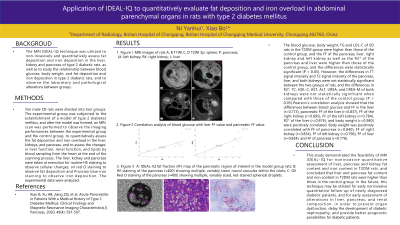
Results: The differences in T1 signal intensity and T2 signal intensity of the pancreas, liver, and both kidneys were not statistically significant between the two groups of rats, and the differences in R2*, TC, HDL-C, AST, ALT, UREA, and CREA-M of both kidneys were not statistically significant when compared with those of the control group (P > 0.05).Pearson's correlation analysis showed that the differences between blood glucose and FF in the liver (r=0.773), pancreatic FF of the liver (r=0.837), FF of the right kidney (r=0.895), FF of the left kidney (r=0.784), R2* of the liver (r=0.876), and body weight (r=0.980) were positively correlated. Body weight was positively correlated with FF of pancreas (r=0.840), FF of right kidney (r=0.854), FF of left kidney (r=0.796), FF of liver (r=0.834), and FF of pancreas (r=0.778).
Conclusions: This study demonstrated the feasibility of MRI IDEAL-IQ for noninvasive quantitative assessment of liver, pancreas and kidney fat content and iron content in T2DM rats, and concluded that liver and pancreas fat content and iron content in T2DM rats were higher than those in the control group.