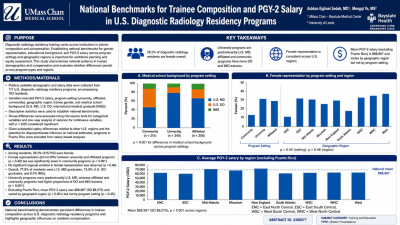
Purpose: Diagnostic radiology residency training varies across institutions in trainee composition and compensation. Establishing national benchmarks for gender representation, educational background, and PGY-2 salary across program settings and geographic regions is important for workforce planning and equity assessment. This study characterizes national patterns in trainee demographics and compensation and evaluates whether differences persist across program types and regions.
Methods/Materials: Publicly available demographic and salary data were collected from 117 U.S. diagnostic radiology residency programs, encompassing 763 residents. Variables included PGY-2 salary, program setting (university, affiliated, community), geographic region, trainee gender, and medical school background (U.S. MD, U.S. DO, international medical graduate [IMG]). Descriptive statistics were used to establish national benchmarks. Group differences were assessed using Chi-square tests for categorical variables and one-way analysis of variance for continuous variables, with p < 0.05 considered significant. Given substantial salary differences relative to other U.S. regions and the potential for disproportionate influence on national estimates, programs in Puerto Rico were excluded from salary-based analyses.
Results: Among residents, 28.2% (215/763) were female. Female representation did not differ between university and affiliated programs (p = 0.40) but was significantly lower in community programs (p < 0.001). No significant regional variation in female representation was observed (p = 0.46). Overall, 77.9% of residents were U.S. MD graduates, 13.5% U.S. DO graduates, and 8.5% IMGs. University programs were predominantly U.S. MD, whereas affiliated and community programs had higher proportions of DO and IMG trainees (p < 0.001). Excluding Puerto Rico, mean PGY-2 salary was $68,967 (SD $8,075) and varied by geographic region (p < 0.001) but not by program setting (p = 0.35).
Conclusions: National benchmarking demonstrates persistent differences in trainee composition across U.S. diagnostic radiology residency programs and highlights geographic influences on resident compensation.